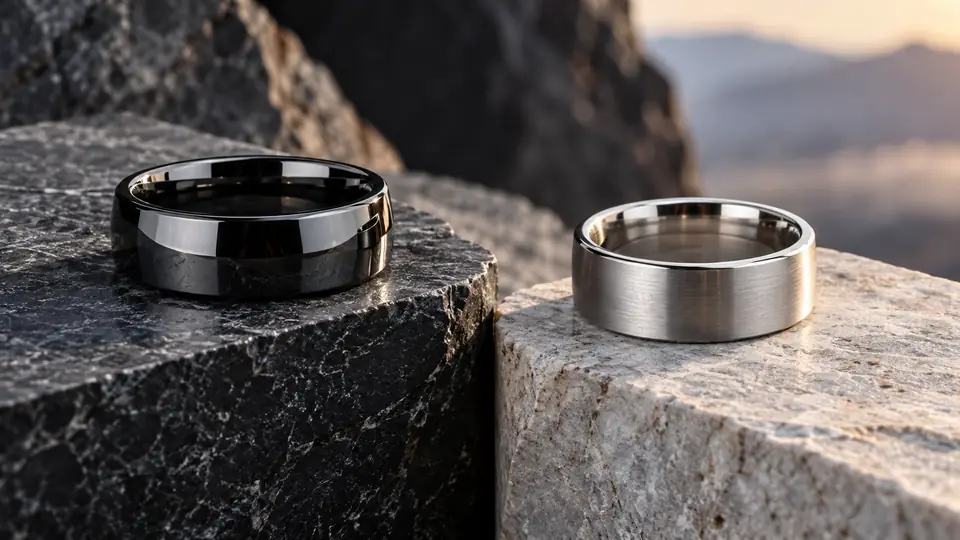
Tungsten vs. titanium rings differ most in weight, hardness, toughness, finish, and sizing options. Most “tungsten rings” are made from tungsten carbide, a hard ceramic-metal composite, while titanium rings are made from titanium or a titanium alloy. Tungsten carbide feels substantially heavier and resists everyday scratches well. Titanium is much lighter, tougher, and easier to modify or remove in an emergency.
Neither material is universally better. Tungsten carbide suits people who prefer a substantial feel and a highly scratch-resistant surface. Titanium is a practical choice for anyone who values light weight, impact resistance, comfort, or a more adaptable ring.
Tungsten Carbide and Titanium: What Are They?
The material names used in jewelry can be confusing. Pure tungsten is a dense elemental metal, but most rings marketed as tungsten rings use tungsten carbide. Tungsten carbide is combined with a metallic binder, commonly nickel or cobalt, then formed and finished for jewelry use. The exact composition varies by manufacturer.
Titanium rings are typically made from commercially pure titanium or a titanium alloy. Titanium is a structural metal with a low density, high strength-to-weight ratio, and strong resistance to corrosion. Decorative finishes, coatings, inlays, and surface treatments can affect the appearance and performance of either ring material.
| Feature | Tungsten carbide ring | Titanium ring |
|---|---|---|
| Typical material | Tungsten carbide with a metallic binder | Commercially pure titanium or titanium alloy |
| Weight on the finger | Heavy and substantial | Very light |
| Surface hardness | Very high scratch resistance | More prone to surface scratches |
| Toughness | Hard but relatively brittle | Strong and more resistant to impact damage |
| Resizing | Generally cannot be resized conventionally | Often difficult to resize, though some constructions allow limited modification |
| Corrosion resistance | Generally good, depending on composition and finish | Excellent for ordinary wear and exposure to moisture |
| Allergy considerations | Depends on the binder and any coatings | Generally well tolerated, but the specific alloy still matters |
Weight and Comfort
Tungsten carbide is much denser than titanium. A tungsten carbide band therefore feels noticeably heavier than a titanium band of similar dimensions. Some wearers associate that weight with quality or permanence. Others find it tiring, especially with a wide ring or during activities that involve frequent hand movement.
Titanium has a low density, so a titanium ring can be comfortable for people who dislike the sensation of a heavy band. Its light weight can also be useful for wide designs, active work, and long periods of wear. The ring’s width, shape, interior contour, and surface finish affect comfort as much as the material itself.
Scratch Resistance and Impact Damage
Tungsten carbide is harder than titanium and generally maintains a polished surface longer under ordinary contact with desks, tools, and other metal objects. This property makes it appealing for people who want a ring that keeps its finish with minimal polishing.
Hardness does not mean immunity to damage. Tungsten carbide can chip or crack if it receives a sharp, forceful impact against a hard surface. The risk depends on the ring’s construction, profile, edges, and the nature of the impact. A damaged ring may show a chip, fracture, or break rather than a simple shallow scratch.
Titanium is softer at the surface and may develop small scratches sooner. Those marks usually do not mean the ring has lost its structural integrity. Titanium’s greater toughness allows it to flex and absorb impacts more readily than tungsten carbide. A titanium ring can still bend, dent, or suffer damage under enough force, so neither material should be treated as indestructible.
Appearance and Finishes
Tungsten carbide rings commonly have a bright polished finish, a dark gray tone, or a black coating. Brushed, satin, faceted, and inlaid designs are also available. A coating can create a distinctive color, but the coating may wear or scratch separately from the underlying material.
Titanium has a naturally gray metallic appearance. It can be polished, brushed, anodized, or treated with a coating. Anodized color comes from a surface oxide layer rather than conventional paint. Finishes can change over time through abrasion, chemical exposure, or contact with other objects.
Inlays require extra care with both materials. Wood, carbon fiber, gemstones, and other decorative components may have different cleaning and durability requirements than the ring body. A ring with an inlay should follow the manufacturer’s care instructions rather than assumptions based on the base metal.
Resizing and Long-Term Fit
Traditional resizing is generally unavailable for tungsten carbide rings. The material cannot be stretched or cut and soldered in the same way as gold, silver, or platinum. If the size is wrong, the usual solution is an exchange or replacement rather than a permanent size adjustment.
Titanium resizing is also limited. Titanium is difficult to work with using conventional jewelry techniques, and many titanium bands cannot be resized economically. Some simple designs may allow modification through a specialist, but the ring’s construction and the jeweler’s equipment determine what is possible.
Accurate measurement matters for either material. Finger size changes with temperature, time of day, activity, and swelling. A ring that fits comfortably should pass over the knuckle with modest resistance while remaining secure at the base of the finger. Wide bands often feel tighter than narrow bands of the same nominal size.
Safety and Emergency Ring Removal
A ring that becomes tight because of swelling can restrict circulation. Pain, numbness, discoloration, coldness, or rapidly increasing swelling requires prompt medical or emergency assistance. Do not rely on forceful pulling or improvised tools.
Tungsten carbide and titanium require different professional removal approaches. Tungsten carbide is brittle enough that trained responders may be able to fracture it with an appropriate ring-breaking tool. Titanium is tougher and may require a specialized cutting tool. The safest method depends on the ring’s exact construction, the finger’s condition, and the available equipment.
Do not attempt to crush, drill, or cut a stuck ring at home. A tool can injure the finger, create heat, or worsen swelling. Emergency personnel, medical professionals, and experienced jewelers can select a suitable removal method.
Skin Sensitivity and Metal Composition
Titanium is often selected by people who want a metal with a strong record of skin compatibility. This does not mean every titanium ring is identical. Alloying elements, surface coatings, adhesives, and decorative inlays can affect individual reactions.
Tungsten carbide rings may contain a nickel or cobalt binder. Some wearers tolerate these materials without difficulty, while people with known metal sensitivities should verify the ring’s composition before wearing it. A label such as “tungsten” does not establish whether the ring contains nickel, cobalt, a coating, or another component.
Persistent redness, itching, swelling, blistering, or discomfort should be treated as a reason to remove the ring and seek appropriate medical advice. The cause may be a metal sensitivity, trapped moisture, soap residue, friction, or another skin condition.
Cleaning and Daily Care
For routine cleaning, wash either type of ring with lukewarm water and a small amount of mild soap. Use a soft cloth or soft brush, then rinse and dry it thoroughly. Remove the ring before using harsh chemicals, handling abrasive materials, or performing work that could expose it to a sharp impact.
- Keep abrasive cleaners and polishing compounds away from decorative coatings.
- Inspect inlays and settings for looseness or gaps.
- Follow the manufacturer’s instructions for black finishes, colored surfaces, and nonmetal inlays.
- Store the ring separately from harder objects that could mark its finish or from items that could scratch its inlays.
Tungsten carbide usually requires less cosmetic maintenance because of its hardness. Titanium may show surface wear sooner, but many scratches are cosmetic and do not affect normal use. Professional refinishing options depend on the ring’s finish and design.
Which Material Fits Different Priorities?
The better choice depends on the properties that matter most to the wearer.
- Choose tungsten carbide if you prefer a heavy ring, want strong resistance to everyday surface scratches, and are comfortable replacing the ring if your finger size changes.
- Choose titanium if you prefer a lightweight band, want greater tolerance for impact, or value a metal commonly used for lightweight and skin-compatible jewelry.
- Check the composition first if you have a known metal allergy. Ask about binders, alloying elements, coatings, and inlays.
- Measure carefully before ordering either material because resizing may be limited or unavailable.
If you prefer the weight and scratch resistance of tungsten carbide, our guide to the best tungsten rings compares specific bands to help you narrow down your options.
Frequently Asked Questions
Are tungsten rings heavier than titanium rings?
Yes. Tungsten carbide is considerably denser, so a ring with similar dimensions usually feels much heavier than a titanium ring.
Which ring scratches less?
Tungsten carbide generally resists everyday surface scratches better than titanium. Its greater hardness also comes with more brittleness under sharp impacts.
Can a titanium ring break?
Yes. Titanium is tough, but it can bend, dent, crack, or break under enough force. Its toughness does not make it indestructible.
Can tungsten carbide rings be resized?
Most tungsten carbide rings cannot be resized through conventional jewelry methods. Replacement or exchange is usually the practical solution for an incorrect size.
Are tungsten and titanium rings hypoallergenic?
Neither label guarantees that every ring will suit every wearer. Titanium is often well tolerated, while tungsten carbide rings may contain nickel or cobalt binders. Verify the actual composition if skin sensitivity is a concern.
Tungsten vs. titanium rings is primarily a choice between heavy scratch resistance and lightweight toughness. Tungsten carbide offers a substantial feel and a durable polished surface, while titanium provides comfort, low weight, and greater tolerance for impact. Accurate sizing, verified composition, and awareness of each material’s limitations matter more than choosing a universal winner.
