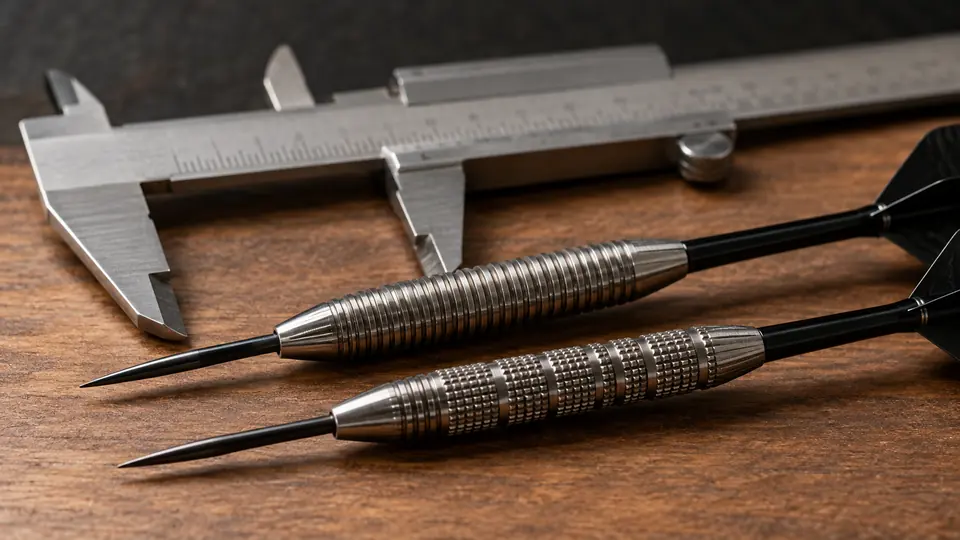
The difference between 80% and 90% tungsten darts is mainly the composition and resulting barrel size. A 90% tungsten barrel can usually be made slimmer than an 80% tungsten barrel at the same weight because the tungsten alloy is denser. That smaller profile may help reduce grouping interference, but it does not automatically make the dart more accurate or suitable for every player.
The percentage describes the approximate tungsten content of the barrel material by weight. It does not describe the dart’s total weight, the amount of tungsten in the complete assembled dart, or a guaranteed percentage of pure elemental tungsten. Manufacturers may use tungsten alloys with additional metals, so the exact composition and density can vary between products.
80% vs. 90% Tungsten Darts At A Glance
| Feature | 80% Tungsten Darts | 90% Tungsten Darts |
|---|---|---|
| Approximate tungsten content | About 80% of the barrel alloy by weight | About 90% of the barrel alloy by weight |
| Typical barrel size at the same weight | Usually somewhat larger | Usually somewhat slimmer |
| Grip and balance | Determined mainly by barrel design | Determined mainly by barrel design |
| Durability | Depends on alloy, machining, finish, and use | Depends on alloy, machining, finish, and use |
| Price | Often less expensive, although construction varies | Often more expensive, although the percentage alone does not set quality |
To compare specific sets, see our picks for the best 80% tungsten darts and the best 90% tungsten darts. When comparing models, check the barrel weight and diameter alongside the tungsten percentage.
What Does The Tungsten Percentage Mean?
Tungsten darts are generally made from a dense tungsten alloy rather than a barrel of pure tungsten. Pure tungsten is difficult to machine into the detailed shapes used for dart barrels, so manufacturers combine tungsten with other metals and process the material into a workable alloy.
An 80% tungsten label generally means that tungsten makes up approximately 80% of the barrel alloy by weight. A 90% label indicates a higher tungsten proportion. The remaining material may include other metals, and its identity can differ between manufacturers. A product description should be treated as the authority for a specific barrel’s composition.
The percentage also applies primarily to the barrel. Shafts, flights, points, soft-tip conversions, rings, and other components are made from different materials. A 90% tungsten dart therefore does not mean that the complete assembled dart is 90% tungsten.
Why 90% Tungsten Darts Can Be Slimmer
Tungsten has a high density compared with many metals used in dart construction. Increasing the tungsten content generally increases the density of the barrel alloy, although the actual result depends on the complete alloy and manufacturing process.
For a similar barrel mass, a denser material requires less volume. That allows a manufacturer to produce a narrower barrel or to place the same mass into a different shape. The difference may be useful for players who group darts closely and want incoming darts to encounter less surface area from darts already in the board.
A slimmer barrel does not guarantee tighter groups. Throwing technique, release consistency, dart weight, barrel profile, grip location, point length, shaft length, flight shape, and practice all affect results. Some players prefer a larger 80% barrel because it offers more surface area for the fingers or creates a shape that suits their grip.
Barrel Size Matters More Than The Percentage Alone
The tungsten percentage is one factor in barrel dimensions, but it does not determine the complete design. Two darts with the same percentage and weight can have different diameters and lengths because their manufacturers use different shapes.
A dart can be lengthened, shortened, tapered, ringed, scalloped, or machined with larger grip sections. Material can also be removed through deep grooves or other profile details. These design choices affect the barrel’s external dimensions and balance.
For a meaningful comparison, check the following specifications together:
- Barrel weight, rather than the total assembled dart weight
- Barrel diameter
- Barrel length
- Front, center, or rear balance
- Grip pattern and grip location
- Point length and shaft length
- Steel-tip or soft-tip configuration
A compact 80% barrel may be slimmer than a long, heavily grooved 90% barrel. The label alone cannot predict the dart’s dimensions or how it will feel in the hand.
Grip, Balance, And Throwing Feel
Grip
Grip comes primarily from the barrel’s machining and surface pattern. Knurling, rings, grooves, scallops, coatings, and smooth sections create different levels of contact with the fingers. A higher tungsten percentage does not automatically produce more grip.
Players who hold the dart toward the front may prefer a front-loaded profile. A central holder may prefer a straight or centrally weighted barrel, while a rear holder may find a rear-loaded shape more natural. These preferences are separate from whether the alloy is labeled 80% or 90% tungsten.
Balance
Balance affects how the dart leaves the hand and how it enters the board. The barrel’s shape, point length, shaft, flight, and grip position all contribute to the finished balance. Changing from one 80% or 90% model to another can create a larger difference in feel than changing the tungsten percentage alone.
Weight
Compare barrel weights carefully. Some listings emphasize the weight of the barrel, while others describe the approximate weight of the assembled dart. Steel-tip darts also gain mass from the point, shaft, flight, and other components. Soft-tip darts may use a different point and may be subject to different equipment requirements.
Is 90% Tungsten Better Than 80%?
Neither percentage is universally better. A 90% barrel may be preferable for a player who wants a slimmer dart at a familiar weight. An 80% barrel may be preferable for someone who likes a slightly wider profile, a particular grip layout, or a lower-cost construction.
The higher percentage does not automatically mean that the barrel is stronger, more durable, or better machined. Durability depends on the alloy, surface finish, groove depth, point construction, use conditions, and impacts between darts. Tungsten alloys are dense and hard, but dart barrels can still show marks or suffer damage from repeated collisions and contact with hard surfaces.
Performance also depends on a player’s consistency. A barrel that fits the hand naturally is usually more useful than a higher-percentage barrel with an unsuitable diameter or grip pattern.
80% And 90% Tungsten Darts For Grouping
Barrel diameter can matter during close grouping. A narrower barrel leaves more open space around a dart already in the board, which may make it easier for subsequent darts to reach nearby target areas. This is a geometric benefit, not a guarantee of improved scoring.
Players who use a wider stance between their fingers or hold the barrel firmly may prefer the additional diameter of some 80% models. Players who place their fingers close together or prefer a compact profile may favor a 90% model. The correct comparison involves throwing the same weight and a similar shape if possible, rather than comparing percentage labels in isolation.
Steel-Tip And Soft-Tip Differences
Both 80% and 90% tungsten barrels can be used in steel-tip or soft-tip darts. The tungsten percentage does not determine board compatibility. The point type, assembled weight, dimensions, and the rules or specifications of the relevant dart setup determine compatibility.
Steel-tip darts use fixed or replaceable metal points for bristle boards. Soft-tip darts use plastic tips and are intended for electronic boards or other compatible targets. Some barrels accept interchangeable points or conversion systems, but compatibility must be confirmed for the particular barrel and component set.
League and tournament rules vary. Check the applicable organization or venue rules for permitted dart weights, dimensions, point types, and equipment before using a particular setup in competition.
How To Compare Two Dart Barrels Fairly
- Match the barrel weight. Compare similar barrel weights rather than relying on the total package weight.
- Check the diameter. This gives a more direct indication of how much space the dart occupies in the hand and board.
- Check the length and profile. A long tapered barrel feels different from a short straight barrel, regardless of alloy percentage.
- Locate the balance point. Compare the balance with the grip position you use during a throw.
- Study the grip pattern. Deep rings, fine grooves, scallops, and smooth sections behave differently during release.
- Confirm the assembled configuration. Shaft, flight, and point choices can alter balance and total mass.
- Check the manufacturer’s specifications. Confirm that the listed tungsten percentage, dimensions, and weight refer to the same part of the dart.
This process often reveals that an 80% barrel and a 90% barrel can have similar practical dimensions, or that two 90% barrels can feel very different because of their shapes.
Common Questions About Tungsten Dart Percentages
Does 90% tungsten mean the dart is made from pure tungsten?
No. The label generally describes the approximate tungsten content of the barrel alloy by weight. It does not mean the barrel is made from pure tungsten, and it does not describe the composition of the complete dart.
Are 90% tungsten darts always thinner?
No. Higher tungsten content can allow a slimmer barrel at a comparable mass, but the final diameter depends on the manufacturer’s design. Length, grooves, tapers, and other machining details also affect the size.
Do 80% tungsten darts break more easily?
The percentage alone does not establish durability. Barrel damage depends on the alloy, manufacturing quality, finish, design, and use. Both types can be damaged by hard impacts or repeated dart-on-dart contact.
Can beginners use 90% tungsten darts?
Yes. Tungsten percentage is not a skill-level requirement. A beginner can use either construction, provided the dart’s weight, dimensions, grip, and balance suit the player’s throw and the applicable equipment rules.
Which percentage should a player choose?
Choose based on the barrel diameter, shape, grip, balance, weight, and total feel. Select 90% tungsten when a slimmer profile is useful and the design fits the throw. Select an 80% model when its dimensions and grip feel more natural or its construction better suits the intended use.
For most players, the practical difference between 80% and 90% tungsten darts is barrel volume and potential slimness. The percentage is a useful starting specification, but the complete barrel design determines how the dart feels, groups, and performs in actual play.
