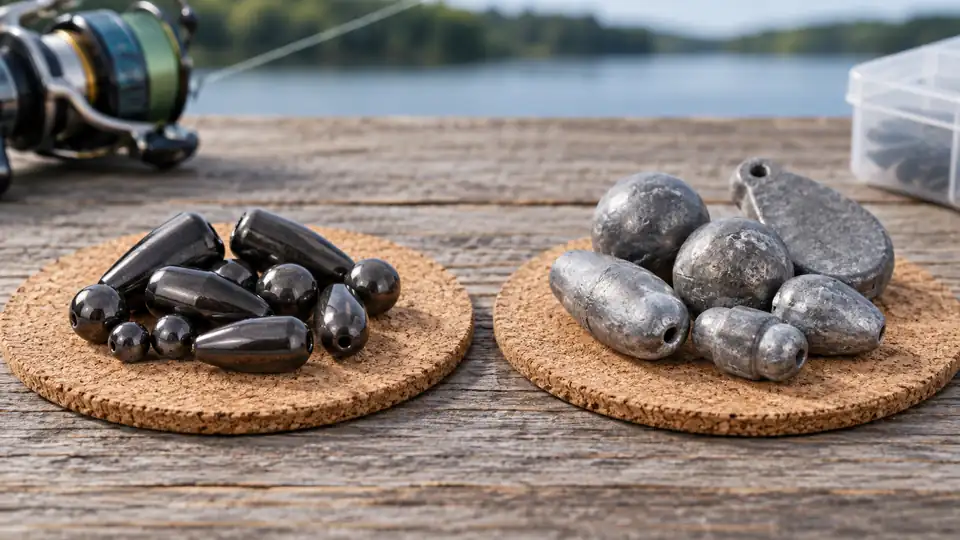
Tungsten vs. lead fishing weights is mainly a comparison of density, size, durability, cost, and environmental considerations. Tungsten is much denser than lead, so a tungsten weight with the same mass can be considerably smaller. That compact size can help a lure pass through cover and may provide clearer bottom contact, while lead remains widely used because it is inexpensive, easy to shape, and available in many forms.
The better material depends on the fishing technique, local regulations, bottom conditions, and budget. Tungsten is often useful for compact bass presentations and finesse rigs. Lead can still be practical for applications where size matters less or where frequent weight loss makes cost a major concern.
Tungsten and Lead Compared
| Characteristic | Tungsten | Lead |
|---|---|---|
| Approximate density | 19.25 g/cm³ for pure tungsten | 11.34 g/cm³ |
| Size at equal mass | Smaller | Larger |
| Hardness | Generally harder, though fishing weights are usually tungsten alloys | Soft and easily deformed |
| Typical cost | Higher | Lower |
| Bottom contact | Can transmit sharper contact through the line | Often produces a softer feel |
| Environmental concerns | Often selected as a lead alternative, but product composition still matters | Lead loss can create environmental and wildlife concerns |
The density figures describe the elemental materials. A finished fishing weight may contain an alloy, coating, insert, paint, or other components, so its exact density and dimensions can differ from these reference values.
Why Tungsten Weights Are Smaller
Density describes how much mass is concentrated in a given volume. Pure tungsten has a density of about 19.25 grams per cubic centimeter, compared with about 11.34 grams per cubic centimeter for lead.
For equal mass, the theoretical volume of tungsten is approximately 41 percent lower than the volume of lead. A finished tungsten weight will not always be exactly 41 percent smaller because shapes, coatings, line inserts, and alloy compositions vary. The density difference still explains why a tungsten bullet weight or drop-shot weight can have a noticeably more compact profile.
For example, a 14-gram weight made from materials with the reference densities would require approximately:
- 0.73 cubic centimeters of pure tungsten.
- 1.23 cubic centimeters of lead.
The mass stays the same, while the volume changes. That difference can affect how a rig moves through vegetation, brush, rocks, and other cover.
How Tungsten Performs on the Bottom
Tungsten fishing weights are valued for their compact shape and firm contact with the bottom. A hard weight can produce a more distinct change in vibration as it touches rock, wood, gravel, or a hard clay surface. Anglers often describe this as improved feedback through the line.
That feedback is conditional. Rod action, line type, lure design, water depth, current, bottom composition, and the connection between the weight and the lure all affect what reaches the angler’s hand. A tungsten weight does not guarantee greater sensitivity in every setup.
Tungsten also tends to maintain its shape better than lead. Lead can flatten, dent, or deform after contact with rocks or repeated use. A tungsten alloy weight may resist those changes, although some products can chip or crack under severe impact. A chipped weight should be checked for sharp edges that could damage fishing line.
Advantages of Tungsten Fishing Weights
Compact Profile
The smaller size of tungsten can help a weighted lure move through dense cover. A compact bullet weight may slip between stems and branches with less surface area catching on nearby material. The benefit depends on the weight’s shape and the cover, so density alone does not determine how easily a rig passes through.
Clearer Contact With Hard Bottom
The hardness and density of a tungsten weight can create a more defined feel during bottom contact. This may help distinguish a rock from softer sediment while dragging a Texas rig, Carolina rig, or similar presentation.
Shape Retention
Tungsten generally resists dents better than lead. A weight that retains its original shape can behave more consistently throughout its service life.
Reduced Lead Use
Many anglers choose tungsten to avoid using lead tackle. Lead is a toxic heavy metal, and lost fishing tackle can pose risks to wildlife in some environments. A tungsten product should still be checked for its stated composition. A coating or label alone does not establish that every component is completely lead-free.
Limitations of Tungsten Weights
Higher Cost
Tungsten weights usually cost more than comparable lead weights. This difference matters in rocky areas, heavy cover, or unfamiliar water where snags and lost tackle are common.
Potential Chipping or Cracking
Tungsten is hard, but hardness does not mean unlimited toughness. Some tungsten-based weights can chip or fracture after repeated impacts. Product construction varies, and a weight with a damaged line passage can create a failure point.
Less Forgiving Around Line
A hard weight can have a sharper edge if its finish is damaged. Inspect the hole, insert, and coating after serious abrasion. Replace a weight that cuts, frays, or pinches the line.
Product Composition Varies
Fishing weights marketed as tungsten are commonly made from tungsten-containing alloys rather than pure elemental tungsten. The amount of tungsten, binder material, coating, and insert can vary between products. Product labeling and manufacturer specifications are the appropriate sources for composition details.
Where Lead Weights Still Make Sense
Lead remains useful in many fishing applications. It is dense enough for practical tackle, simple to cast into complex shapes, and relatively inexpensive. Its softness also makes it easy to crimp, pinch, or adjust in some weight styles.
Lead can be a reasonable choice when:
- The weight will be used in open water with limited snag risk.
- The technique requires frequent changes or repeated weight loss.
- The weight’s larger profile does not interfere with the presentation.
- Local rules permit the use of lead tackle.
- Low cost is more important than maximum compactness.
Lead should be handled carefully. Avoid chewing split shot or placing lead tackle in the mouth, wash hands after handling heavily oxidized or dirty weights, and store tackle away from children and pets. Follow local disposal guidance for damaged or unwanted lead weights.
Technique-Specific Differences
Texas Rigs and Flipping Weights
Tungsten bullet weights are popular for Texas rigs, punching presentations, and flipping because the compact profile can move through vegetation and cover. The weight may also provide more distinct contact with hard structure. Lead remains functional, particularly in open water or situations where snag loss is frequent.
Drop-Shot Weights
Both materials are available for drop-shot fishing. Tungsten can provide a compact bottom weight and a firm feel, while lead can reduce replacement costs when the weight is attached below the hook and frequently encounters snags. Cylindrical, teardrop, and other shapes may affect snag resistance more than material alone.
Jig Heads
Material is one part of a jig head’s performance. Hook design, head shape, balance, skirt or soft-plastic attachment, and line tie position may have a greater effect on how the lure swims and rests. A tungsten jig head may be compact, but it is not automatically the best fit for every lure or depth.
Fly-Tying Beads
Tungsten beads are used to add weight to flies while keeping the bead relatively small. This can preserve a slimmer fly profile while helping the pattern sink. Bead diameter, hook size, hook gap, and the fly’s materials must match properly. A bead that is too heavy or too large can alter the fly’s balance and presentation.
Environmental and Legal Considerations
Lead tackle restrictions vary by jurisdiction, waterway, species, and tackle type. Some rules address specific sizes of sinkers or jigs, while others apply to particular waters or protected wildlife areas. Check the current fishing regulations for the location where you plan to fish rather than relying on a general statement about lead restrictions.
Tungsten is often selected as a lead alternative, but it should not be treated as automatically harmless in every form. The finished product may include binders, coatings, paint, or other materials. Prevent the loss of any fishing weight where possible, collect discarded tackle, and dispose of damaged weights responsibly.
How to Choose Between Tungsten and Lead
Match the material to the demands of the presentation:
- Choose tungsten when a compact profile, firm bottom contact, or reduced lead use is a priority.
- Choose lead when affordability, easy replacement, or a larger soft weight is acceptable.
- Check the shape because bullet, cylindrical, teardrop, and other designs behave differently in cover and around snags.
- Inspect the line passage for burrs, cracks, damaged inserts, or rough coating.
- Verify local regulations before using lead tackle in a new lake, river, or protected area.
A practical approach is to use tungsten in situations where the smaller profile or increased bottom feedback has a clear purpose, then use lead where lost weights are common and those advantages are less important.
If tungsten suits your setup, see our guide to the best tungsten fishing weights to compare specific options by shape, weight, and rig.
Frequently Asked Questions
Is tungsten heavier than lead?
For the same volume, tungsten is heavier because it is denser. For the same mass, a tungsten weight occupies less space than a lead weight. The finished dimensions depend on the product’s alloy and construction.
Are tungsten fishing weights better than lead?
Neither material is universally better. Tungsten offers a smaller profile and can provide distinct bottom contact, while lead is less expensive and easy to replace. The appropriate choice depends on the technique, cover, regulations, and budget.
Are tungsten fishing weights completely lead-free?
Some products are manufactured and labeled as lead-free, but the claim should be confirmed through the product’s specifications or manufacturer information. The word tungsten by itself does not verify the composition of every component.
Can tungsten weights damage fishing line?
A properly finished weight with a smooth insert or line passage should be suitable for its intended use. A chipped, cracked, or rough weight can abrade line, so inspect it after impacts and replace it if the passage is damaged.
Why are tungsten weights more expensive?
Tungsten-based materials cost more to produce and process than lead, and manufacturing a compact weight with a suitable finish or insert adds to the expense. The price reflects material and construction costs rather than a guarantee of better results in every fishing situation.
Practical Takeaway
Tungsten vs. lead fishing weights is a tradeoff between compact size and cost. Tungsten is useful where a smaller weight can improve lure clearance through cover or provide more defined contact with the bottom. Lead remains a practical option for many rigs because it is affordable, widely available, and easy to replace. Select the material, shape, and size around the fishing technique, then follow the regulations for the water you fish.
